
By picovoyage · Reviewed 2026-11-16 by Picovoyage
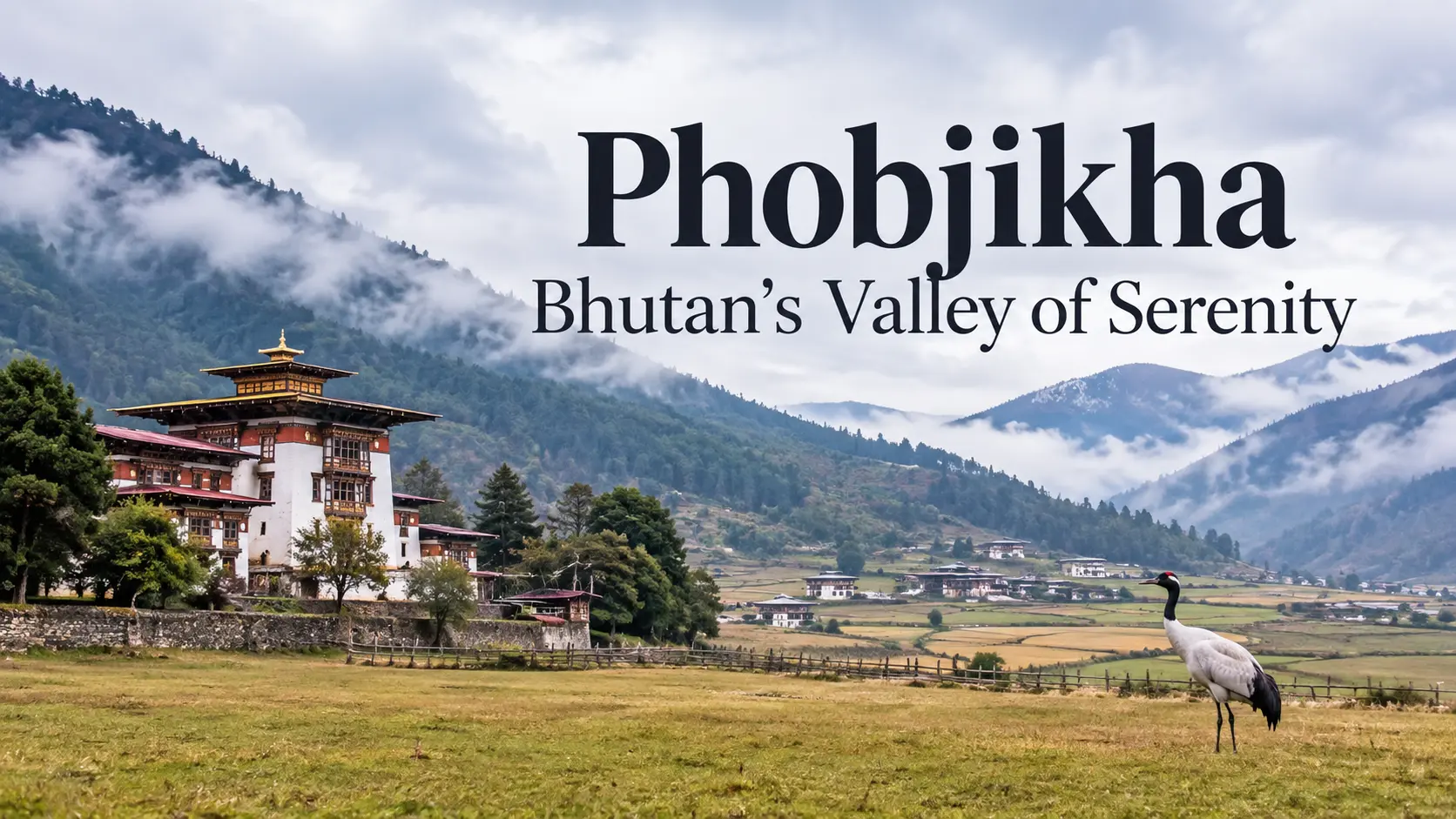
Phobjikha Valley, Bhutan, has long been a mystery waiting in the mountains. This enormous U-shaped glacier valley is located at around 3,000 meters in Wangdue Phodrang. The valley is carpeted with wide meadows and dwarf bamboo, surrounded by the Black Mountains. Travelers know it as Gangtey, Bhutan, named after the monastery overlooking it. Each winter, Bhutan’s black-necked cranes call Phobjikha home, and the entire valley seems to calm down, ready to welcome them.
Here we begin our guide to the valley, its environment, and how its landscape was formed. Then we visit Gangtey Monastery to learn why the cranes return each year. We see the main tourist sites and walks, see the hotels and resorts that melt into the hillside, and finish with the crane festival and village life that give the valley its heart.
Where Is Phobjikha Valley in Bhutan? Landscape and Setting
Phobjikha Valley lies behind the Black Mountains in Wangdue Phodrang district. The Black Mountains run for more than 5,000 meters along its western flank, dividing western Bhutan from the country's central section. That natural wall is what makes the valley so tranquil, and so far away from everything. The valley panorama is one of the most tranquil settings in the Himalayas, and travelers generally refer to the area as Gangtey Bhutan, or simply the Gangtey Valley.
Phobjikha Valley Altitude, Wetlands and the Gangtey Valley Floor
The Phobjikha Valley is about 3,000 meters above sea level, so the air is clean, the sky is wide, and the mornings are cool and clear. Ice shaped this land into a broad U-shape a long time ago. These days, the Gangtey valley floor is a soft mix of marsh and grassland. Each winter, black-necked cranes come to this open, wet ground.
The valley's natural value is recognized even beyond Bhutan. It was declared a Ramsar wetland of international importance on 2 May 2014. Ramsar wetlands are important worldwide. It is surrounded by a protected area of around 163 square kilometers and includes the gewogs of Phobji, Gangtey and Bjena.
These marshes could have been converted to cropland once. The Bhutanese government abandoned that proposal, and the marsh remained unchanged. That decision is one reason Phobjikha still looks the way it does today.
Who, now, maintains this dangerous landscape in good condition? TheRoyal Society for the Protection of Nature (RSPN) oversees the protected area alongside the local families who farm and live here. Their care keeps the marsh healthy for the cranes and for the community that calls the valley home.
Let's go up the ridge above the wetlands and visit Gangtey Monastery (Gangteng Goenpa), where history, architecture and the Pema Lingpa lineage are merged. Remember the beauty of the valley and its setting.
Gangtey Monastery (Gangteng Goenpa): History, Architecture and Pema Lingpa Lineage
Gangtey,Bhutan, is perched on a ridge above the marshes of the Phobjikha Valley. It stands silent guardian over the marsh. It is situated on a ridge overlooking the marshes. Across the Phobjikha Valley, it stands in quiet, a sentry above the marsh. The first Gangteng Trulku, Pema Thinley, established the monastery in 1613. He is the grandson of famed treasure revealer Pema Lingpa, and the monastery represents a part of the family’s spiritual tradition. Originally a modest lhakhang, it was expanded by the second Trulku, Tenzin Legpai Dhendup, into the grander building seen today.
Inside Gangtey Monastery: Prayer Halls, Monastic Life and Daily Rituals
Today Gangtey Monastery is the major seat of the Pema Lingpa tradition and the largest Nyingma monastery in western Bhutan. The 9th Gangteng Trulku, Kunzang Rigdzin Pema Namgyal, heads it. Next to it is a shedra, or monastic college, where young monks learn and pray. In the morning, step into the courtyard, and you will hear a slight hum of chanting coming from the prayer halls- the everyday cadence of monastic life at Phobjikha.
The building has a narrative to tell as well. Between 2002 and 2008, the complete monastery was renovated in traditional materials and dedicated on 10 October 2008 in the presence of the Fourth King. Visitors may enter the courtyard and, weather permitting, the assembly hall, but prayers and ceremonies have precedence. Talk quietly and take it gradually. Let the place set the pace. This is part of what makes Gangtey Monastery one of the most unforgettable tourist destinations in Phobjikha Valley.
With the monastery's story in your heart, look out over the wetlands below: each winter, a beautiful visitor from the Tibetan Plateau comes to make Phobjikha its home, and the reason for its return is a story in itself.
Why Do Black-Necked Cranes Winter in Phobjikha Valley?
Black-necked cranes migrate annually from their breeding grounds on the Tibetan Plateau across the Himalayas to the Phobjikha Valley to winter and then return. The valley is a protected, milder habitat, and its wide wetlands offer the roosting and feeding grounds the birds need for the cold months. Hence, Gangtey Valley is the best place to see these rare birds in Bhutan.
Black-Necked Crane Visitor Centre and Conservation Work
The cranes normally arrive in late October, and locals hold a ceremony to welcome them. On arrival, the birds circle Gangtey Monastery thrice and do the same circles while departing for Tibet in mid-February or early March. It is one of the most affecting sights in Phobjikha and is seen by many residents as a godsend.
Counts have been around 600 or more in recent winters, which says a lot about how well the valley is looked after. The Royal Society for Protection of Nature (RSPN) has monitored the cranes since 1987. RSPN restores their roost sites every year in mid-September, just before the birds return, so the marsh is ready. Cranes are also formally protected in Bhutan.
At the RSPN tourist center in Phobjikha, they talk about the cranes' ecology and the conservation work that goes into protecting them. A short halt here enhances your experience in the valley as you get a sense of what you are looking at in the wetlands.
Fast facts to plan around:
- Arrival and departure: Late October to mid-February or early March.
- Peak viewing: mid-November to mid-January.
- Viewing etiquette: keep a respectable distance from roosting sites.
Having visited the cranes and learned how the valley protects them, it's time to explore the rest of Phobjikha on foot, from moderate hikes and open overlooks to quiet cultural places.
Phobjikha Valley Tourist Places: Trails, Viewpoints and Cultural Sites
The tourist spots in Phobjikha Valley aren't huge attractions to tick off. They are about gentle treks, open views, and quiet cultural venues you may experience at your own pace. Most are within walking distance, and that's what makes the Phobjikha Valley in Bhutan feel so personal.
Gangtey Nature Trail and Other Walks Across the Valley Floor
A good place to begin is the Gangtey Nature Trail. It's an easy 4 km downhill journey that takes 1.5 to 2 hours. The walk starts from the mani wall north of Gangtey Monastery and ends at Khewa (Khewang) Lhakhang. Along the way, you pass through blue pine woodland, patches of dwarf bamboo, the town of Semchubara, a community school, and open meadows. How difficult is it? The hike is of moderate difficulty. It's all downhill from there, so most people finish with ease. In winter, the cranes live in the wetland below. In warm months, meadows turn green and fresh.
If you want to stay longer on the floor of the Gangtey Valley, there are further walks. Popular local walks include Gogona, Khebaythang and Kilkhorthang, all of which take you a little further into rural life and calm countryside. Taken together, these walks make Phobjikha one of the most walkable valleys in Bhutan, and you will often stop to watch the light dance across the marsh.
A quick peek at the Gangtey Nature Trail:
- Trail: 4 km, easy to moderate, downhill.
- Stops: Village of Semchubara, community school and Khewa Lhakhang.
- Scenery: winter wetland with cranes, verdant meadows in the summer months
After a day of walking through pine forests and open meadows, you will be delighted to discover that the valley also boasts a great variety of eco hotels and resorts, where warm interiors and vast valley views make for the perfect spot to rest.
Phobjikha Resort and Hotel Scene: Eco-Lodges and Valley Views
The resort and hotel scene in Phobjikha is small, calm, and charming. Packed in here. Nothing tall. Instead, the valley has eco-lodges, tucked into the slopes, with great windows looking out over the marshes and the pine forests beyond. Everything feels of the earth, built to honor the serenity of Gangtey, Bhutan, not to outshine it. Whether it's a Phobjikha resort nestled in the trees or a modest hut perched on a ridge, the view is always the same: wide meadows, moving mist, and the valley's slow pace beyond your window.
Hotel in Phobjikha: Design, Facilities and Setting Near Gangtey Monastery
Phobjikha Valley hotels offer a charming mix of styles, from tiny luxury lodges with 8 to 12 suites to heritage-style hotels, boutique resorts, and family-run lodges. Most are built in traditional Bhutanese and farmhouse architecture, generally with rammed-earth walls that blend into the terrain. A hotel in Phobjikha, perched on forested ridges or amid the pines, will almost always provide a valley-facing room and a view you won't want to leave. A day's strolling, and then a night in the iron stoves and traditional hot stone baths at 3,000m, makes for a comfortable winter's night.
The environment and design are both beautiful. Gangtey Bhutan's main landmarks are nearby, with several residences within walking or driving distance of Gangtey Monastery and the Black-necked Crane Center. Whichever style you choose, the stay is part of the experience. Quiet evenings, mountain air, lazy mornings above wetlands.
A glance at lodgings in the valley:
- Types of properties: Luxury lodge, heritage-style hotel, boutique, and family-run.
- Typical features include: hot stone baths, valley-facing rooms, iron stoves.
- Location: Most are a short walk or drive from the monastery and the crane center.
Nestled in a snug valley, you're ready to meet the people and traditions that bring Phobjikha to life, especially during the crane festival.
Black-Necked Crane Festival and Village Life in Phobjikha
The black-necked crane festival welcomes the winter guests to Phobjikha Valley, Bhutan. Life in the valley is, for the most part, a quiet rhythm of prayer, the seasons, and farming. Then the cranes return from the Tibetan Plateau and the whole village comes out to meet them. Families and students, like the monks, participate, emphasizing the value of these birds to village life in Phobjikha. The cranes are not just passing through. They are the identity of the valley and the festival is the way the people of Gangtey, Bhutan, thank them for coming back.
Crane Festival at Gangtey Monastery: Mask Dances and Local Traditions
Every year on 11 November, the courtyard of Gangtey Monastery is filled with color, music, and happy crowds. The Royal Society organizes the event for the Protection of Nature (RSPN) in cooperation with the local environmental committee, and it began as a way to raise awareness about crane conservation. You ask what's so unique about it? Schoolchildren dress as cranes and perform the crane dance and a traditional mask dance called cham.
It's also the birthday of the Fourth King, so it's more of a celebration. It takes place every year on 11 November. The next celebration will take place on 11 November 2027.
When the dances are over and the cranes are back in the wetlands, you start to grasp why this valley is so hard to forget.
Why Phobjikha Valley Stays With You Long After You Leave Gangtey
The Phobjikha Valley in Bhutan is one that you remember for a long time after your visit, bringing a quiet serenity to your mind. It's the quiet of Gangtey Monastery, the chanting wafting over the courtyard, the grip of time loosening. The blessing before any schedule is to see black-necked cranes circling overhead. It’s the pace of village life, slow, waking to mist in the mornings and ending with woodsmoke over the fields at night.
Phobjikha stays with you, which is why it feels so peaceful. You visit the tourist places in Phobjikha Valley, stay in a comfortable hotel in Phobjikha, or see the cranes on your own, and leave with a mind at ease. If the call of this region speaks to you, let Picovoyage help you plan a trip to Bhutan to experience it all.
Frequently Asked Questions
Where is Phobjikha Valley in Bhutan?
Phobjikha Valley is in Wangdue Phodrang district in central-western Bhutan. The Black Mountains run along its western edge, and travellers also call the area Gangtey Bhutan or the Gangtey Valley.
What is the altitude of Phobjikha Valley?
The valley sits at about 3,000 metres above sea level. At this height, the air is crisp, the skies are wide, and winter nights are cold.
Why is Phobjikha Valley a protected wetland?
It was named a Ramsar wetland of international importance on 2 May 2014. A conservation area of about 163 square kilometres surrounds it, covering the Phobji, Gangtey and Bjena gewogs. The Royal Society for Protection of Nature (RSPN) manages it with local families.
Who founded Gangtey Monastery, and when?
The first Gangteng Trulku, Pema Thinley, founded Gangtey Monastery in 1613. He was the grandson of the treasure-revealer Pema Lingpa. The second Trulku, Tenzin Legpai Dhendup, later expanded it from a small lhakhang into the larger complex seen today.
Can visitors go inside Gangtey Monastery?
Visitors can walk into the courtyard, and into the assembly hall when the day allows. Prayers and ceremonies take priority, so some flexibility helps. The monastery was restored between 2002 and 2008 and consecrated on 10 October 2008.
Why do black-necked cranes winter in Phobjikha Valley?
The cranes breed on the Tibetan Plateau and fly over the Himalayas to escape the cold. Phobjikha is a sheltered, milder valley, and its wide wetlands give them the roosting and feeding grounds they need. Counts in recent winters have been 600 or more.
When do the black-necked cranes arrive and leave?
They arrive in late October and leave between mid-February and early March. Peak viewing is from mid-November to mid-January. On arrival and departure, they circle Gangtey Monastery three times.
How long is the Gangtey Nature Trail?
The trail is about 4 km and takes 1.5 to 2 hours. It runs downhill from the mani wall north of Gangtey Monastery to Khewa (Khewang) Lhakhang. It is easy to moderate and passes pine forest, dwarf bamboo, Semchubara village, a community school and meadows.
What kind of hotels and resorts are in Phobjikha Valley?
The valley has small luxury lodges with 8 to 12 suites, heritage-style hotels, boutique properties and family-run lodges. Many use traditional Bhutanese and farmhouse styles, with rammed-earth walls and valley-facing rooms. Iron stoves and hot stone baths keep guests warm in winter.
When is the Black-Necked Crane Festival held?
The festival is held every year on 11 November in the courtyard of Gangtey Monastery, and the next one is on 11 November 2027. RSPN organises it with the local environment committee to raise awareness of crane conservation. Schoolchildren perform the crane dance dressed as the birds, alongside a traditional mask dance called cham.
Related Tour Packages
Bhutan Tour Package – 6 Nights 7 Days
- Hotel Stay
- Sightseeing
- Cab Transfer
- Meals
Bhutan Tour Package – 7 Nights 8 Days
- Hotel Stay
- Sightseeing
- Cab Transfer
- Meals